Type vs Interface in TypeScript: When and Why to Use Each
🧩 Type vs Interface in TypeScript
In TypeScript, we have two ways to declare types: using the type keyword or the interface keyword.
They basically do the same thing, but there are a few key differences between them, and we’re going to cover those in this article.
⚡ TL;DR
- Both
typeandinterfacecan define object shapes. typecan also describe primitives, unions, and intersections.interfacesupports declaration merging and extending multiple interfaces.- For composition, prefer
interface extendsovertype &, since it’s faster and more predictable. - Personally, I default to
typeunless I specifically need something that onlyinterfaceprovides.
🧠 The Basics
Interfaces are used only to describe objects, while types can describe not only objects but also primitive values like string, number, boolean, and more.
For example, you can do this with a type:
type Address = string;

const address: Address = "123 Main Street";
But you can’t do the same with an interface! Interfaces can only describe object shapes.
🔀 Declaration Merging
One of the most important features that differentiates interface from type is called Declaration Merging.
This means that if we declare multiple interfaces with the same name, TypeScript automatically merges them together.
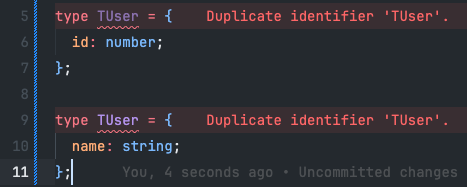
If we try the same with types, we’ll get an error.
// ❌ Type alias throws an error
type User = {
  id: string;
};

type User = {
  name: string; // Error: Duplicate identifier 'User'
};
// ✅ Interfaces are merged automatically
interface User {
  id: string;
}

interface User {
  name: string;
}

const user: User = {
  id: "1",
  name: "John Doe",
};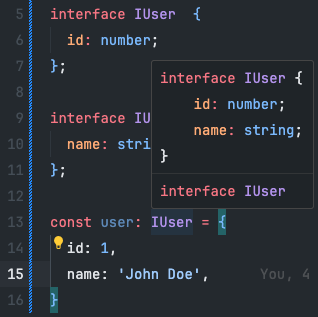
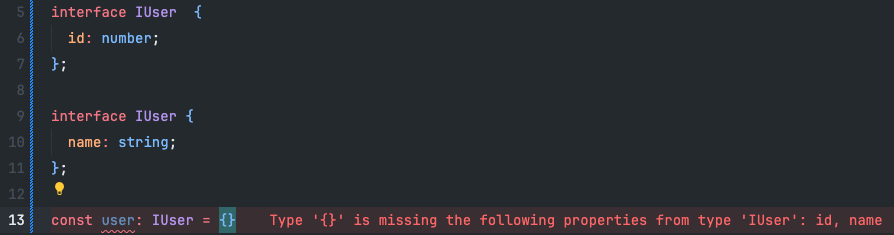
Notice how the interface version merges both declarations.
It even gives us a type error if we try to create a User object without id or name, because both properties now exist in the final merged type.
💡 Tip: It’s common among TypeScript developers to use prefixes or postfixes when naming types and interfaces, like
IUser,TUser, orUserType.
⚙️ Performance Considerations
When it comes to performance, in modern TypeScript (especially after the rewrite of the compiler in Go), there’s not much difference between using type or interface for most use cases.
However, there’s one specific scenario where interfaces can perform better: when handling type extensions.
According to the official TypeScript performance guide, interfaces are cached internally, while type intersections (&) are recomputed each time they are used.
In other words:
// 👎 Recomputed every time
type Foo = Bar & Baz & { someProp: string };

// 👍 Cached and more efficient
interface Foo extends Bar, Baz {
  someProp: string;
}
So, when you’re composing multiple types, prefer using interface with extends rather than type with &.
🧩 The Official Recommendation
The TypeScript documentation suggests defaulting to interfaces when possible.
However, my personal preference is to default to type, unless I specifically need a feature that only interfaces provide.
While declaration merging can be powerful, it can also lead to unexpected issues in large codebases with many developers, especially when people are unknowingly extending the same interface from different parts of the code.
🧭 Conclusion
Both type and interface are powerful tools in TypeScript, and they often overlap.
But understanding the small differences helps you make better design decisions in your code.
✅ Use interface when:
- You want to extend or merge structures.
- You’re defining contracts or public APIs.
✅ Use type when:
- You need unions, primitives, or complex compositions.
- You want a simpler and more flexible syntax.
Ultimately, consistency matters more than strict rules, so pick one approach that fits your team’s style and stick with it.